Run the work.Not five different apps.
Scheduling, invoicing, inventory, receipts, contractors. Flip on only the tools you need and keep it all in one place.
I built Linchpin because friends and family kept asking me for the same few tools for their businesses. Then I figured everyone could use them.
How it works
Three steps from sign up to paid. No setup marathon.
Step 1: Pick your modules
Turn on invoicing, scheduling, inventory, receipts, or contractors. Just the ones that fit how you work.
Step 2: Send your first invoice or schedule
Fire off an invoice or share your booking page. You can try it all with sample data first.
Step 3: Get paid
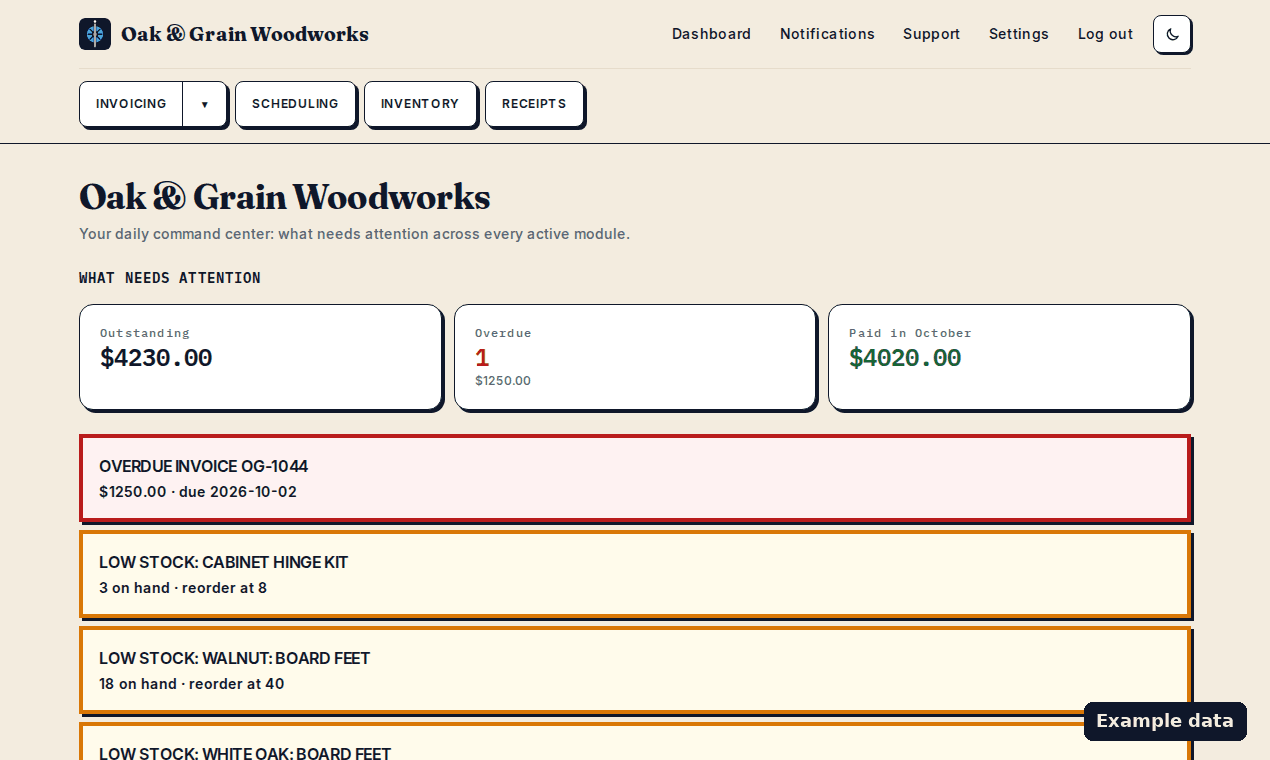
Clients pay online from the invoice. You see what's paid and what's still out on one screen.
The modules
Priced per month, each on its own. Start with one, add more when you're ready.
Invoicing
$9/moCreate and send invoices, track payments
Scheduling
$9/moCalendar and appointment booking
Inventory
$7/moTrack items and quantities
Receipt & Invoice Capture
$5/moOCR scanning and storage of receipts/invoices
Contractor & 1099 Management
$15/moManage contractors, collect W-9s, track payments, and see who's over the 1099-NEC line
Bundle & save
Every module is à la carte. The catch that works in your favor: the more you run, the less the whole thing costs. The discount applies to your entire monthly bill automatically.
Billed monthly. Turn a module on and you're set for the month; turn it off anytime and it simply stops renewing. You keep access through the month you already paid for.
1–2 modules
Full price
3+ modules
applied to your whole bill
5+ modules
applied to your whole bill
Guides from the shop floor
Short workflows for getting paid and booking the week. Written for one-person shops, not enterprise binders.
Guide
How to invoice consulting clients
Scope, quote, optional deposit, then invoice on a trigger you already named.
Guide
House cleaning invoices and schedule
Book the visit, do the clean, send the invoice, mark it paid. Repeat.
Guide
Lawn care invoicing and scheduling
Match the route, the stop, and the invoice so unpaid visits stop vanishing.